How Prepwick works, and the research behind it
The answer
Prepwick rests on a few well-studied ideas. Answering questions teaches more than rereading, and practice spread over weeks lasts longer than cramming. The weakest skill gets the time, and a mistake gets an explanation right away. Points reward effort instead of scores. No study has measured Prepwick itself, and Prepwick promises no score.
By Ryan, a Brooklyn parent. His son took the SHSAT and the HSPT in fall 2025, and his daughter tests in fall 2027.
Facts checked against the official pages listed at the bottom. Dates and rules change every year. Prepwick is not affiliated with NYC Public Schools, Riverside Insights, Scholastic Testing Service or any school named here.
The short version
- Practice testing and spaced practice rated as the two most useful of ten study techniques in a major review.
- A solid skill comes back for a quick review after 3 days, then 7, then 14. Miss it, and it goes back into practice.
- Streaks have a day off built in, and there are no leaderboards.
- We have not found a published study that measures how much test prep adds on the SHSAT, TACHS or HSPT.
What research is Prepwick built on?
Each part of Prepwick follows a finding from learning research. The table names the finding, the study and what Prepwick does with it.
| Idea | What the research found | What Prepwick does |
|---|---|---|
| Practice with questions | Practice testing was one of the two most useful of ten techniques; rereading and highlighting did not consistently help | Daily practice is questions, and each test has timed practice tests |
| Testing beats restudying | Students who took practice tests remembered more a week later than students who restudied, though restudying felt better | A missed question gets a similar one to answer, not a page to reread |
| Spaced review | Across 317 experiments, the best gap between study sessions grew with how long the memory needs to last | Reviews after 3, 7 and 14 days |
| Praise effort | Children praised for being smart did worse after a setback than children praised for effort | Points for showing up and finishing, never for scores |
| Reward inputs | Paying students for the work raised achievement; paying for results did not | Streaks and points count practice done, not right answers |
| Keep prizes small | Tangible rewards lowered children's own interest in a task; positive feedback raised it | No prizes. The weekly report suggests one thing to say to your child about how it is going |
Why does Prepwick use questions instead of lessons to read?
Because answering questions teaches more than rereading. A review of ten study techniques rated practice testing as one of the two most useful, and found that rereading and highlighting do not consistently improve performance.
In one experiment, students who took practice tests on a passage remembered more of it a week later than students who restudied it, even though restudying made them feel more confident.
Why do skills come back after 3, 7 and 14 days?
So that what a child learned in the spring is still there on test day. A review of 317 experiments on spaced study found that the best gap between sessions grows with how long the memory needs to last. Prepwick brings a solid skill back after 3 days, then 7, then 14, and a miss sends it back into practice.
- StartSkill becomes solidAfter practice on the weakest skill
- Review 1Quick review3 days later
- Review 2Quick review7 days after that
- Review 3Quick review14 days after that
Miss a review, and the skill goes back into practice.
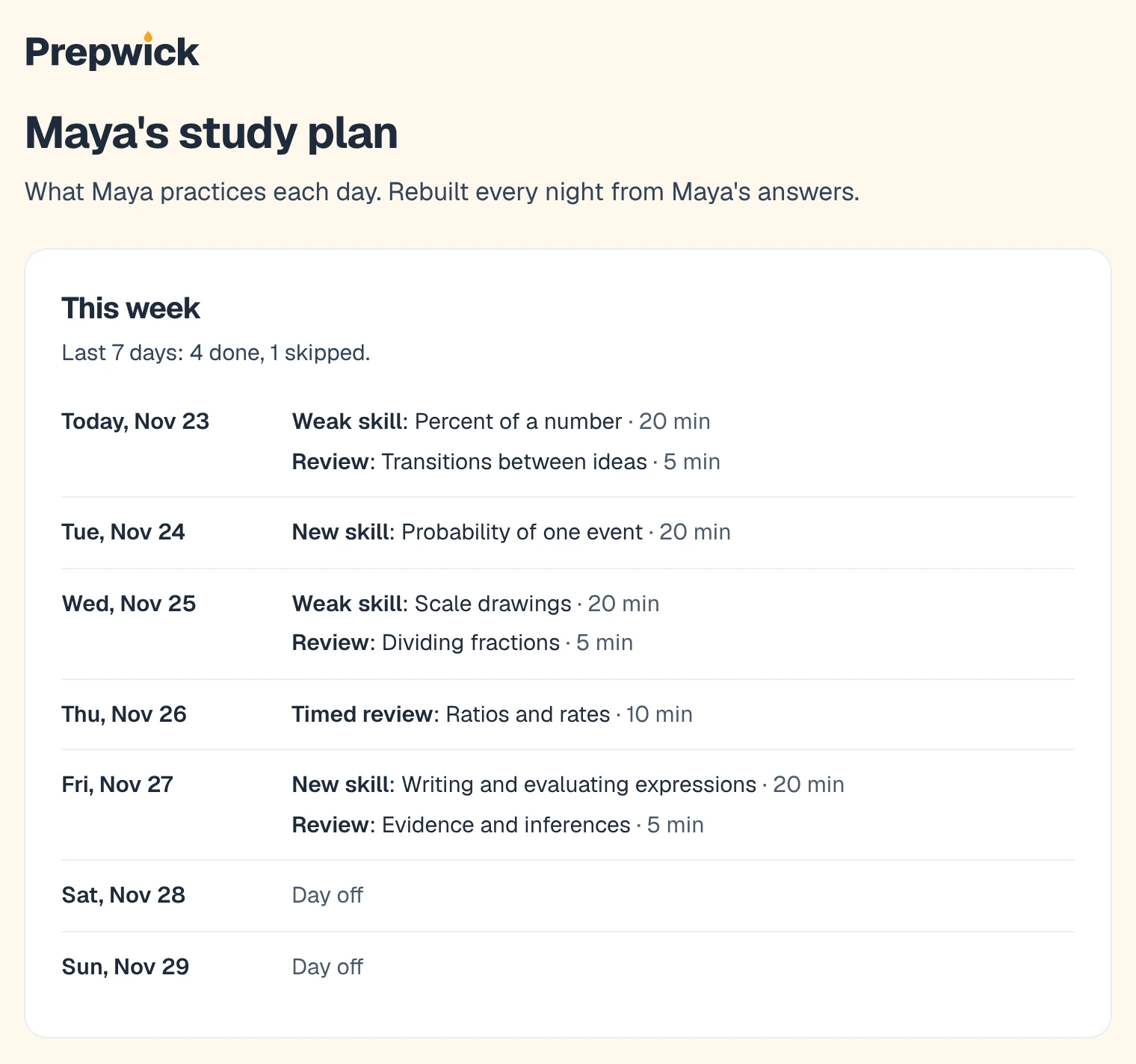
The week's plan
Why does Prepwick pick the weakest skill first?
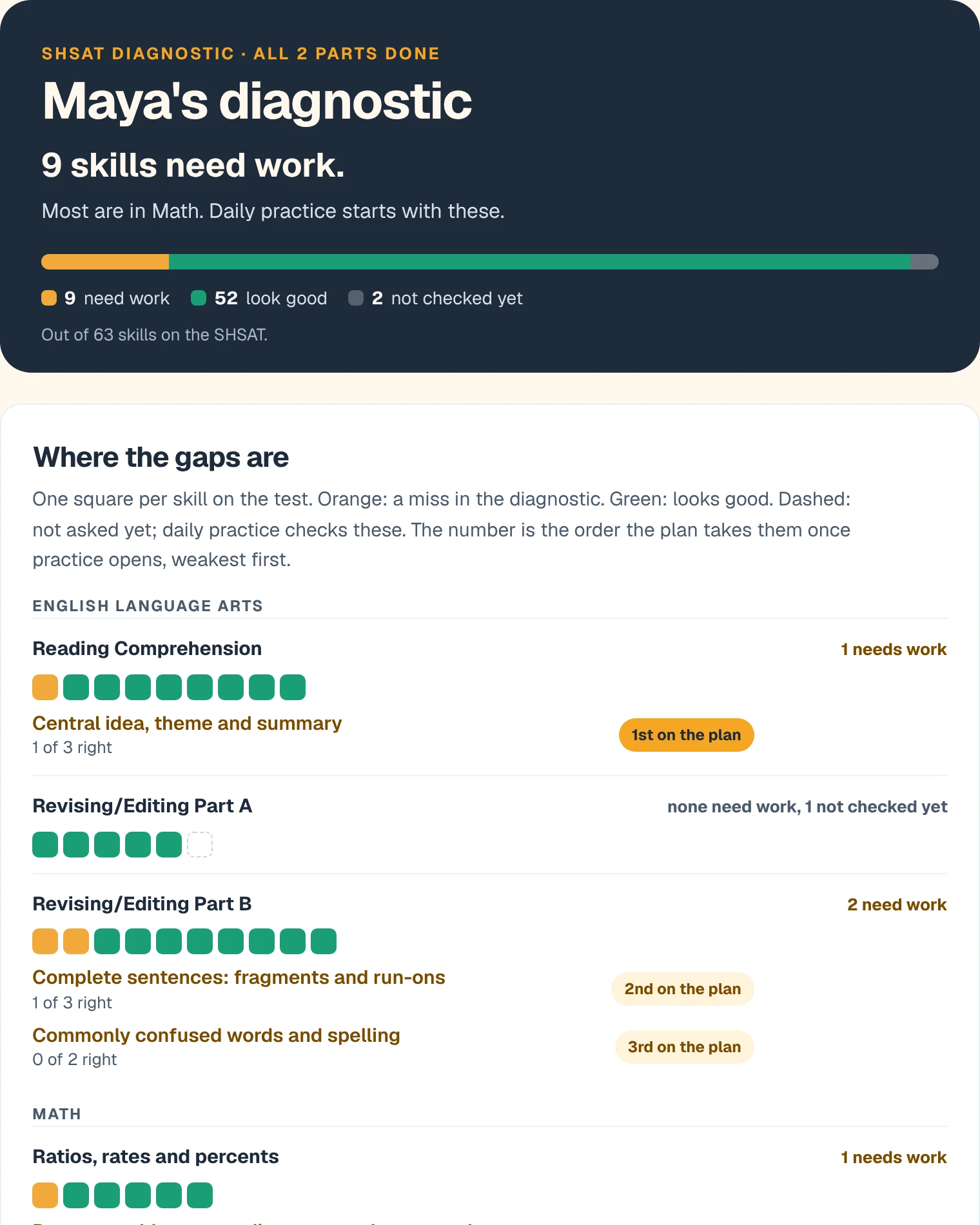
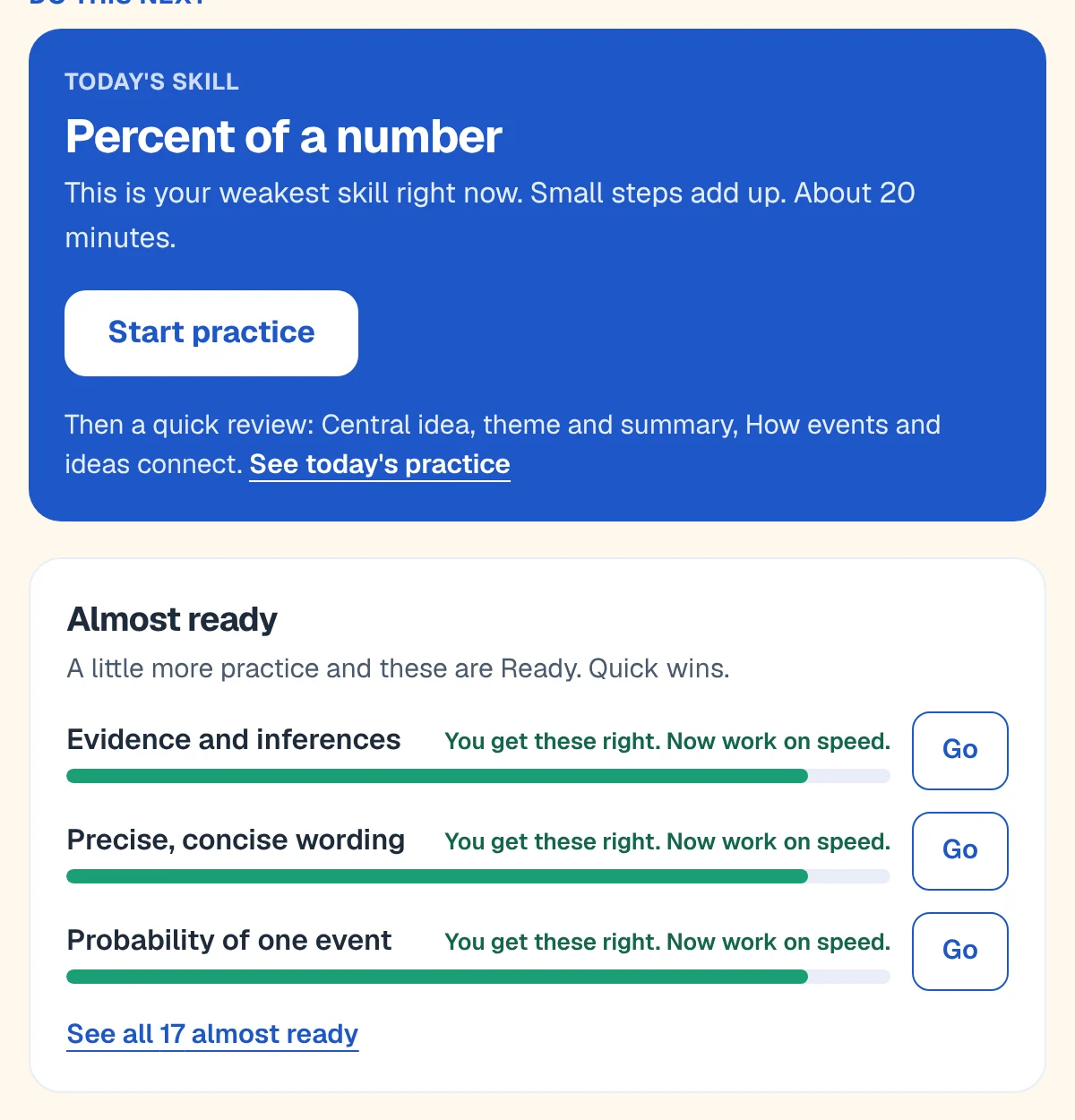
Because time is short, and it should go where it is needed most. A free diagnostic builds each child's skill map. Each night Prepwick picks the weakest skill for tomorrow, and between two equally weak skills it picks the one the test asks about more often.
How often a skill comes up is counted from the test maker's own material where it exists: NYC's four official SHSAT practice forms and the HSPT publisher's sample profile. TACHS publishes no counts.
The diagnostic report
Today's skill
How does Prepwick explain a mistake?
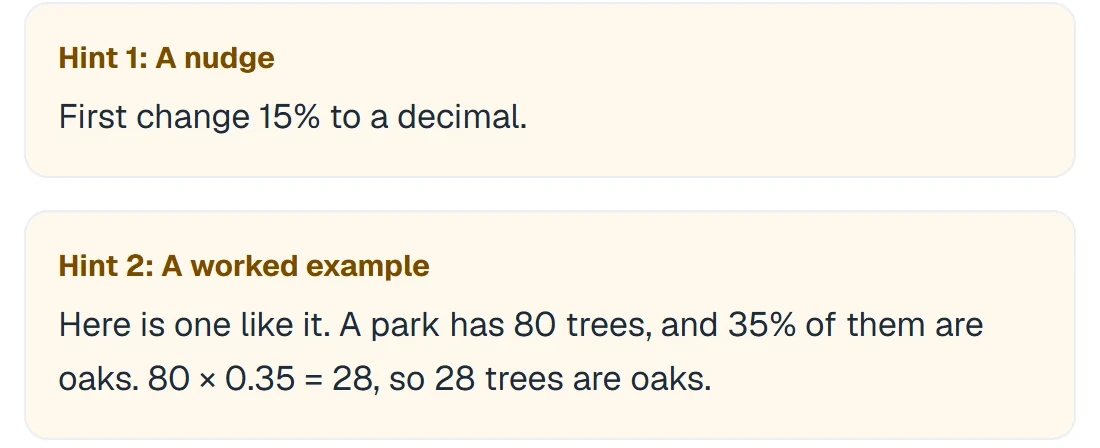
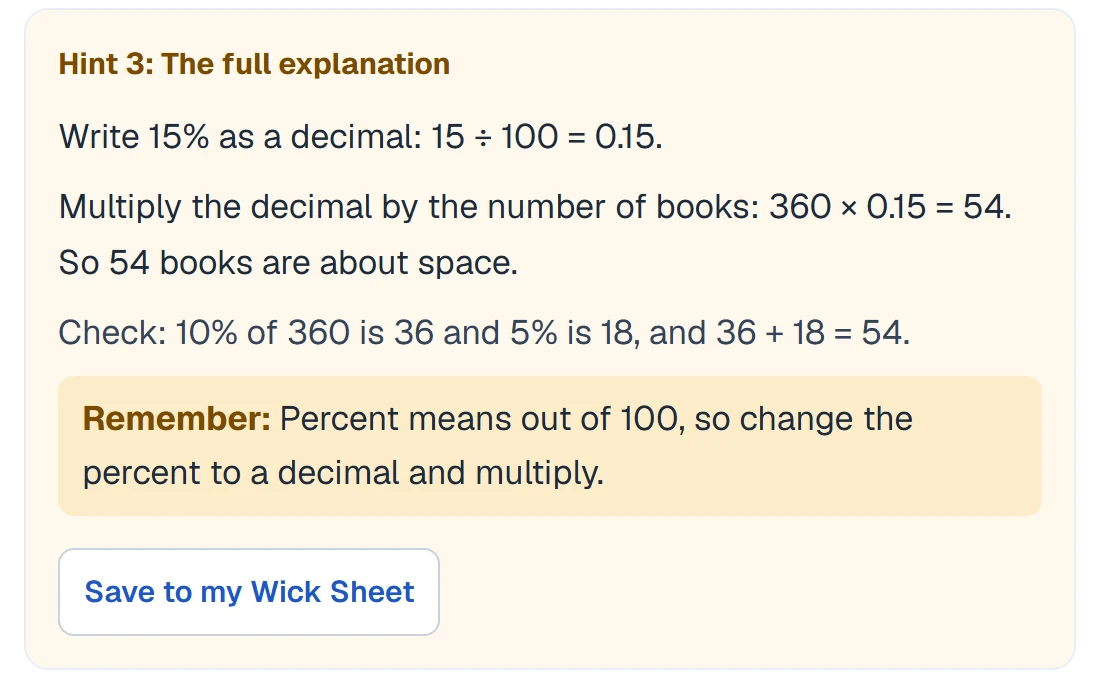
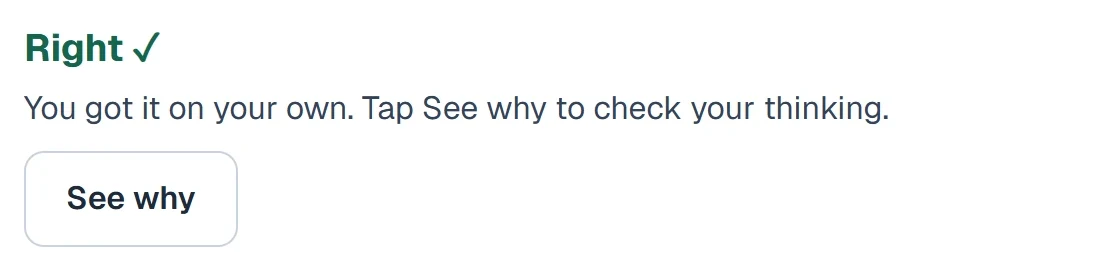
Right away, one step at a time. After a wrong answer, Wick shows where it went wrong, then a worked example, then the full solution, then a similar question. Explanations are written ahead of time, at about a 6th grade reading level, and every math question is solved twice and checked by code.
A review of tutoring research found that computer tutors that coach step by step came close to human tutors. Prepwick's explanations go step by step for that reason. No study has measured Prepwick, so the design is all we claim.
1. Why that answer is wrong
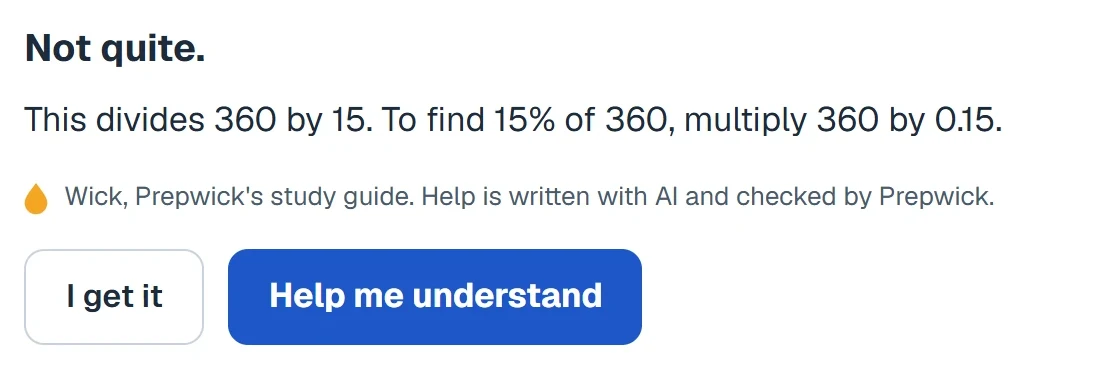
2. A nudge, then a worked example
3. The full solution
4. A new question like it
Why points for effort and not for scores?
Because praise and rewards shape how children handle a setback. In six studies, children praised for being smart did worse after a setback than children praised for effort. Randomized trials in more than 250 city schools found that paying students for the work raised achievement, and paying for results did not.
- Points for showing up and finishing, not for scores.
- Streaks with a day off built in, so one missed day does not wreck the week.
- No leaderboards.
- Choice matters too. Across 41 studies, having a choice raised motivation and effort, more for children than adults, so let your child help pick the practice days.
More questions parents ask
Is Prepwick based on research?
Its design follows research on practice testing, spaced review and motivation, named on this page. No study has measured Prepwick itself.
What is spaced repetition?
Coming back to something at growing gaps instead of all at once. Prepwick brings a solid skill back after 3 days, then 7, then 14.
Does Prepwick use AI?
Behind the scenes. AI drafts questions and Wick's notes, and every math question is solved twice and checked by code. Wick never chats with your child.
How long does Prepwick take each day?
About 20 minutes, on the days you set.
Find out which skills your child needs
The free diagnostic checks your child on every skill on the test and shows which ones need work. Two sittings of about 40 minutes.
Read next
Sources
- Dunlosky and others (2013), Improving Students' Learning With Effective Learning Techniques, Psychological Science in the Public Interest
- Cepeda, Pashler, Vul, Wixted and Rohrer (2006), Distributed practice in verbal recall tasks: A review and quantitative synthesis, Psychological Bulletin
- Mueller and Dweck (1998), Praise for intelligence can undermine children's motivation and performance, Journal of Personality and Social Psychology
- How the Prepwick app works, as Prepwick describes its own product
- Prepwick's own view, not a research finding
- Prepwick's own search of published research, October 2026
- Roediger and Karpicke (2006), Test-enhanced learning: Taking memory tests improves long-term retention, Psychological Science
- Fryer (2011), Financial Incentives and Student Achievement: Evidence from Randomized Trials, Quarterly Journal of Economics
- Deci, Koestner and Ryan (1999), a review of experiments on rewards and intrinsic motivation, Psychological Bulletin
- NYC Public Schools, official SHSAT practice tests A to D and explanations (NYC SHSAT portal)
- Scholastic Testing Service, HSPT Interpretive Manual (2021), with a sample Performance Profile for Form 02J
- TACHS, frequently asked questions
- VanLehn (2011), The Relative Effectiveness of Human Tutoring, Intelligent Tutoring Systems, and Other Tutoring Systems, Educational Psychologist
- Patall, Cooper and Robinson (2008), The effects of choice on intrinsic motivation and related outcomes, Psychological Bulletin